Treadmills, Mirrors and More

We have some appointments down at Mott Children’s in the next couple of weeks – follow-ups with Pediatric Neurology and Pediatric Urology. So before another round of medical posts, here’s just an update on life in general.

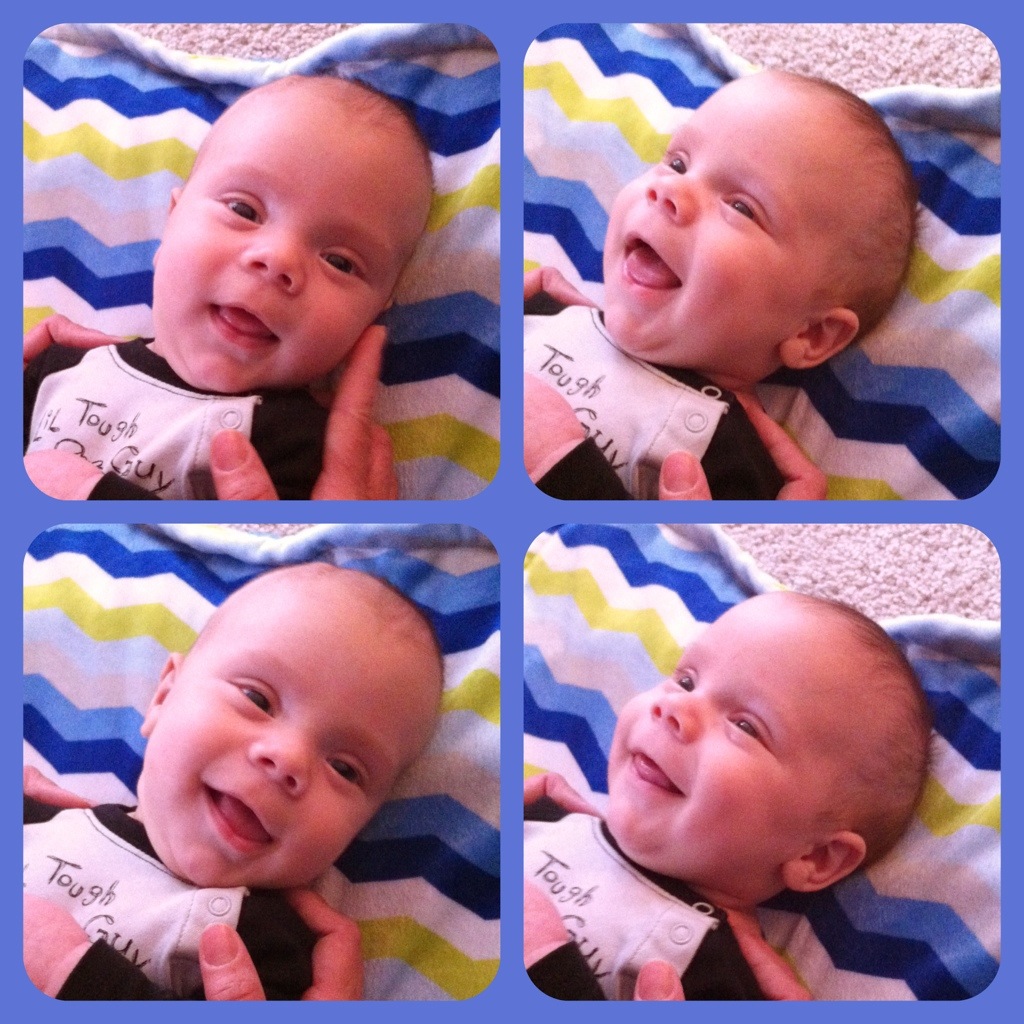
Those of you that know us know that our family leans a little to the MSU side of things – both Richard and I are graduates of State. Well, leaning a little is putting it lightly really. My husband bleeds green. However, with the University of Michigan C. S. Mott Children’s Hospital being the place that fixed up our little guy, Richard actually donned a maize U of M shirt while we were there, and bought the whole family matching shirts! The statement on the front says, “Hail to the Little Victors”. Here is Colten happily showing his off:
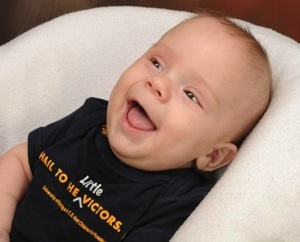
20130120-134324.jpg

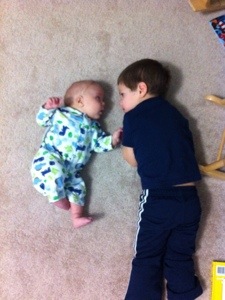
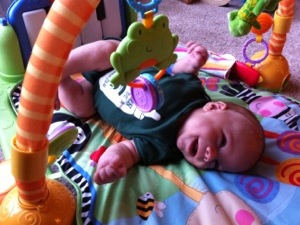
Colten is doing great and just enjoying the luxurious life of a three-month-old… Sleeping, playing in play yards, swinging in swings, nursing, spending time in baby wraps and carriers, having two older brothers in his face…
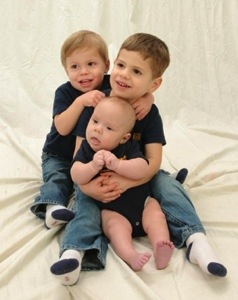
20130120-134411.jpg

He continues to get EarlyOn PT every other week, Anat Baniel Method therapy will now be every week, and treadmill work every day – plus assessments every other week from the treadmill study team. And tons of other lovin’ from us! We even had a dear friend introduce us to Brain Gym too, so now while playing we incorporate some Brain Gym work. Mostly just moving arms and legs across the body. We even received some input on this from our Anat Baniel practicioner, Bethany. She encouraged us to do the Brain Gym movements in more random movements, since random movements are what babies do naturally to learn about their body, and to take the movements slowly and not pull past resistance. From what I understand so far, this cross-midline experience is very stimulating and challenging for the brain and can benefit children and adults of all ages and development ranges. She also informed us that the area of the brain that controls the hands is close to the area that controls the feet. So any stimulation we do to hands we should follow with foot stimulation to help try and make connections. I am still unsure about some of this since it seems pretty unclear whether the nerves Colten has even go to his toes, etc… But we are open to trying to give him the best shot possible.

20130120-141023.jpg

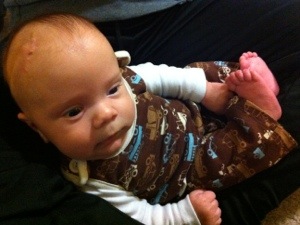
We have not seen any other changes in movement. Colten has strong quadricep (thigh, or front upper leg) muscles. He seems to have some hamstring (back of upper leg) muscles and inner thigh muscles. He is not displaying lower leg movement (ankles, feet, toes), except an occasional upward pull, or flexion, in the left foot. I state this again as we have been to a few gatherings recently where people are surprised that he is moving his legs. Yes, he does move them! His lower leg appears to be moving, and even his feet “move”. But they move as an extension and result of his upper leg muscles. The feet flop wherever due to the movement of the rest of his leg. Hip and gluteus (butt) muscles control much of the upper leg movement. Upper leg muscles control much of the kicking, pushing, and pulling in of the lower leg. Lower leg muscles control the rotation of the lower leg and the ankle. That is what he seems to be missing. And no toe control either. Hopefully that makes sense. I will work on video taping this more clearly soon.

The rest of today’s post is just some Colten cuteness to enjoy!

MIRROR LOVIN’
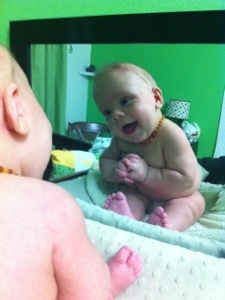
20130119-114528.jpg

Video of Colten loving on himself in the mirror.

TREADMILL TIME
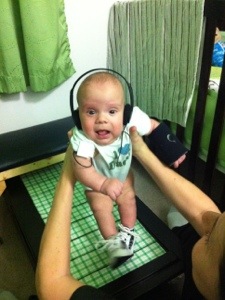
20130119-114708.jpg

Treadmill Time Video

Okay. Totally kidding. He’s not listening to anything and he doesn’t wear shoes while doing treadmill work. Here’s a real video of how he actually is on the treadmill!
Myelomeningocele Treadmill Study

That’s it! I’m sure we will be around again with updates over the next couple of weeks.

20130120-141031.jpg

Amoxicillin is Only Good for Two Weeks

In case you didn’t know that, now you do! We did not. Colten has been getting his daily dose from a bottle originally opened back in November. Thankfully, his dose is small (1mL) and just preventative. Because his urine refluxes back up into his kidneys, the amoxicillin is to prevent a UTI (the urologist is giving Colten’s body time to resolve this issue. If it’s not resolved by the time he’s about four months, they will have to surgically fix it for him).

When I called the pharmacy to refill the prescription, the person on the line made some comment about how the bottle would be large but to only use it for two weeks. I startled… Uh, two weeks?! No one told me that, and the expiration date on the bottle I have right now is empty! The person on the other end of the line seemed quite concerned. I reassured her that it was preventative and he didn’t seem to be displaying symptoms so let’s hope we’re all good and just get on the active bottle. I did put a call into the urology team at Mott Children’s Hospital and they went through a list of questions and said, “ok, he should be fine!”

20130110-221037.jpg

I started thinking back though. I had just called Mott’s Neurology team the week before because something had seemed off with Colten but I couldn’t quite figure it out. After Christmas, he had started sleeping a LOT and even seemed to be spitting up more. There was one day where he only had three awake hours. Literally. He would get up, eat, play for a bit and go right back to bed only an hour after waking. We were seeing him take six-hour-long daytime naps, and still sleep at night. You would think we would just sit back and enjoy having a child that goes to sleep as easily as he does and stays asleep as long as he does! Instead we worried something was wrong. But we did take advantage of the infant-free time to get Christmas disassembled, toys re-arranged, and even got to enjoy some toddler-only-time with our other two sons.

Colten did have a few periods where he seemed a little fussier than normal, but not terribly. He was still quite happy for most of his awake times. So I asked around and every mom told me something different. I heard it all: He’s growing… It’s a tummy virus… Maybe he’s constipated… Could be a shunt issue… But when it came down to it, he was alert when he was awake, he was growing, he was eating, smiling, filling diapers, had a soft fontanel. The neurology department said to watch him but they think he’s okay. So I pushed aside the feeling that anything was wrong.

Today though, we are on day two or three (they kind of start to run together) of some dry diaper changes. There was one night where he slept all night – and not the kind of newborn “all night” that is really just from 11pm-5am, but as a mom, you’re thinking – hey, if 5-6 hours at night is considered the medical definition of sleeping through the night, I WILL TAKE IT! As time moves on, you realize that while great at the time, you just want them to really REALLY sleep all night – as in 8pm-8am. And that’s almost what Colten did. He slept from about 9pm-6am. And woke up just about dry. Sure, he wasn’t nursing all night but it still seems weird that he could go that long and have an almost dry diaper. He had nothing left in him from the last feeding of the night? That was followed by a few more dry or very light diapers. So I called urology AGAIN.

Apparently now I’m “that mom” that is going to be neurotic about everything. But I do admit it to the nurses at least. I keep finding myself saying, “If this was either of my other two sons, I would not have thought much about it, but it’s Colten…” We so badly want to raise him how the other two were raised – somewhat hands-off when it came to medical stuff. We try not to get worked up about a slight fever, we avoid unnecessary medication for ear infections if they are not severe or painful, we try natural remedies, alternative treatments, natural supplements, good diets, and just overall good health to keep our systems in shape. We don’t always win at it, but we do pretty good. Colten is stirring the pot for us though. We are looking at things very differently and trying to figure this whole spina bifida and hydrocephalus thing out. Things that would be worry-free in our other boys at that same age – spitting up a bit more, sleeping a bit more, a random dry diaper… These can all be signs that something could be wrong when you’re looking at these symptoms in a child with spina bifida.

So today during my second call to urology, she went through the list of questions. I hemmed and hawed over quite a few of them…
“Is he eating ok?”
“Mostly. Kind of. He’s on and off a bit more but yeah, he’s still eating.”
“Does he have a temperature?”
“He’s felt warm on occasion to me but anytime I take his temperature, it’s normal.”
“He’s having some soiled diapers still?”
“Yes, but he’s having dry ones and that’s just NOT like him.”
“Is he lethargic?”
“He is sleeping more than he used to, but when he’s up, he’s wide awake, alert and happy. And actually he’s had more awake time the past two days than we saw the previous two weeks.”

I feel like there are all of these, “yeah, but…” instances. In the end, it’s just a matter of watching him for changes or signs that something is wrong. Recently, we have been going through the days questioning, feeling like something might be off but we’re unable to put our finger on it and no strong symptoms are emerging to clue us in. Something will seem wrong, like the dry diaper, and we can usually find some excuse why it’s not really wrong, it’s just a change in circumstances. So we aren’t sure if we’re finding excuses, stretching reality, missing something, or if there really is something not right for our little man.

20130110-221200.jpg

When we took him in for his shunt revision back in November, just two weeks after his shunt was first placed, we both knew something was clearly NOT right with him. But the doctors in the ER kept wavering, looking for something more concrete and not finding it at first. They were ready to send us home and I pushed a little harder – got stronger in my conviction that something in fact WAS wrong and I was not comfortable leaving. Eventually they did the ultrasound and found that, hey, what do you know?! The shunt had indeed failed. So while I am glad my “Momma’s gut” helped in that situation, I’m not nearly as confident this time around that something is actually wrong. It just feels, well, not right.

This is certainly one of our take-away lessons hitting us full force. We have to learn to trust our guts and to trust the medical community. Sometimes they are at odds and that’s when we have to figure out which of us is making the best decision for Colten.

For now, since he seems content and happy, continues to thrive, isn’t showing any other significant symptoms, and all the medical people we spoke with have told us he’s fine, we’ll chalk it up to our neurotic minds and over-protective guts. But don’t think for a second I haven’t started writing down every detail about his diaper changes, feedings and naps! Just in case I need to call urology a third time this week.

We Have Movement in the Right Ankle!

The day after Christmas, Richard and I enjoyed a quiet, post-holiday-chaos evening at home with just Colten. Parker and Max stayed at my parents’ after the Christmas day festivities. Good thing too… I think Parker had consumed at least five cookies between 8-9pm!

We had just finished watching a movie and Colten was sound asleep on me. Usually I do not put socks on him because we are constantly poking at his toes and watching his feet. And since he cannot move his toes, socks end up giving him nasty toe-jam. You know, that lint/fuzz that gets stuck between your toes? It’s nasty. And I get to clean it out. So less sock-wearing means less toe-jam. Yesterday he had socks on though, since he was out running errands with his Daddy earlier. I took his socks off as he laid there asleep and noticed that instead of being cozy warm from being inside the sock, his right foot was quite cold. Typically, people with myelomeningocele do have reduced blood flow to the areas of the body lacking motor and/or sensory function. Colten’s feet are always a little on the slightly cool side. Nothing significant. Could even simply be because I don’t put socks on him. He does have reduced flow though – we know this because the person re-drawing his newborn scan barely got any drops out of his feet at our last appointment. Either way, I was quite surprised at just how cool his foot felt after having the sock removed. I noticed the sock had left an indentation above his ankle and figured even just the slightest pressure reducing circulation must have a greater impact on him since his flow is already reduced. So I started massaging his leg and foot to get the blood flowing a bit more. Then I started scratching, pinching and poking at the bottom of his right foot. Previously, we have seen some slight flexion in the left. Nothing in the right though. Until today!

As a pinched a part of the bottom of his right foot, I apparently pissed him off enough in his sleep, or the simple pain sensation triggered it, but he flexed up that right foot! Over the last two days we have been poking some more when he’s awake. It provided mixed results. I saw flexion during a full body stretching episode and once again while pinching. But I pinched many more times and got no response. But no other movement. So it seems to be very involuntary, almost simply bodily response based if that makes sense. An involuntary reaction. The fact that we saw any movement at all though is promising for future development.

Colten continues his treadmill work each day and has done some amazing stepping sequences. It’s hard to remember that the point of the treadmill is bone strength and really has little to do with walking. There is a chance it could improve his gait and of course provide a stronger foundation. But we won’t know walking status until Colten can show us what he wants to do.

Hope you all enjoyed your holiday festivities. Colten had a great first Christmas with his brothers, parents, grandparents,

A New Therapy Adventure Begins

We have been to a lot of appointments in Colten’s short life. Most of them revolve around doctors reminding us what is wrong, what he cannot do, or the future hardships he may endure. We get a lot of paperwork that talks about disabilities, insurance, assistance, programs and more.

Today’s appointment was different. We had our first appointment with Bethany Snow, an ABM (Anat Baniel Method) Practitioner. We had heard about this therapy about a year and a half ago or maybe even longer, from Richard’s cousin Cheryl. She and her son were being treated as part of Bethany’s training certification process. She needed hours, they were intrigued by the therapy, it all worked out. Sure, she asked about his spina bifida, but she focused on what we knew we had working. She wanted to focus on that and use it to his advantage.

In Colten’s case, the idea is to help him become aware that he has feet and calves and to gradually figure out how to use them. In a traditional PT setting, Colten would be encouraged to keep up with the timeline for typically developing children. Often, devices and other assistance is used to kind of push kids to keep up and do what other kids that same age are doing. However, children born with myelomeningocele are not typically developing – just as many young children in therapy are not typically developing. ABM uses each child as their own measuring stick. It takes into account that there is a typical flow of movement and learning in children, from rolling to sitting to rocking to crawling to pulling up to cruising to walking. Traditional PT works to move kids along at regular intervals. ABM works to move kids along at their own pace in their own time. Instead of giving them outside sources to force the body into a position or movement, it focuses on working on the body to send signals to the brain to let the brain know – hey, I can do this. It works on making connections that for whatever reason (birth defect, neurological disorder, etc…), are not currently being made.

20121220-205556.jpg

The ABM website has an explanation and a link to one of the chapters in Anat Baniel’s book that help explain a little about how this differs in mindset from traditional physical therapy. You can read that HERE if you’re so inclined.

I found this article about the interference of AFO’s (ankle foot orthotics) with the brain’s ability to improve and learn very interesting.

20121220-205609.jpg

So we are moving forward. We are going to start with once every other week and see how it works. At only 2.5 months of age, there isn’t much he is suppose to be doing yet that he isn’t already, so it’s not as if we need to hurry up and get going. But the faster we can make solid brain/body connections, the better off he will be when it becomes time to really need those connections to exist. We know a few other families using this therapy with their myelo children and they are seeing incredible results. They have gone so far as to discontinue their regular PT. They have multiple appointments each week. One of the boys, not expected to walk without assistance, is walking completely on his own. We are paying cash for these appointments as they are not covered by Colten’s insurance, which is why we’re opting for the once every other week frequency to start. And we have a huge THANK YOU in advance to the MANY of you that have generously donated to Colten’s needs – because of you we can do this for him! And yes, you do have thank you notes coming – we are terribly slow on getting them all done.

On that note, we hope all of you have a great holiday season with your families! We are especially aware of the giving spirit this year as we have been the recipients of so many people’s generosity. It’s been an awkward position to be in and we humbly thank all of those that have reached out. We cannot wait to be in a position to pay it forward one day! We are grateful to be able to enjoy this holiday season with our family and friends around us. Thank you for being part of our adventure!

This Little Piggy…

[This post was originally drafted on 12/14 but I forgot to remove it from draft mode; so the reference to “today” isn’t really today, 12/20!]

I never realized how often I touch babies’ toes, or how often everyone touches babies’ toes, until everytime it happens I am reminded that he cannot feel it. That certainly doesn’t stop us from touching his toes constantly, it’s just weird to imagine what it feels like to NOT feel them. Obviously it is all Colten will ever know so its not weird to him.

I guess it would be like… Hair. Don’t laugh! Seriously. I have hair but I don’t feel my hair. I can’t control my hair. I can feel where it connects to my scalp and I can move it by moving my head but I cannot independently feel my hair or make it move. Totally not the point of this post, but I was trying to think of something we all have that we can’t feel or move. That’s the best I could come up with!

Today Colten had to get his newborn screen redrawn. They do this so many hours after birth and I guess Sparrow Hospital drew it too soon. It is a blood draw via heel prick that tests for various rare but serious disorders. I don’t expect anything to come of the test but the interesting part was the heel prick process itself.

We went to the lab this morning and the phlebotomist put a warm pack on Colten’s foot to help draw the blood down and open the capillaries. Thinking I was all smart and not wanting him to get all riled up, I had her do the right foot. He didn’t even wince when she poked him. Yay! Then she struggled to get enough blood for just the first of five dots. I couldn’t figure out what the issue was, thinking it was her, then I rembered a conversation with another mom of a girl with Spina Bifida recently, and remembered the lack of proper blood flow these kids have. I mentioned to the lady that he didn’t have any sensation in his feet and didn’t have good blood flow down there, but might have slightly better “stuff” on the left side. So after a few minutes of not getting anything else on the right, she warmed up the left. It still took another 10-15 minutes to get enough blood to completely fill the circles on the card. I really expected this to be straightforward, and it’s not like it was a big procedure or anything but I had hoped to be in and out more quickly than I was.

20121220-201329.jpg

Then I realized that all my reasons for thinking this would be easy were the exact reasons it was difficult! Great that he can’t feel much there but it meant not enough blood flow. Great that he can’t feel much there but that also meant he didn’t feel the prick or squeezing, so he didn’t flare up and cry like I recall my other boys doing, getting his blood flowing. So we continue to learn even the littlest tips on life with this little man.

Colten is finally over his cold and is a pretty happy little man. He loves being worn close to Momma and Daddy, gets big smiles when big bro Parker smiles at him, and hears “Cuuute” from Max about 20 times a day.

20121220-201356.jpg

Colten’s Feet Play Piano

Here is a prelude to the video at the end of this post…

In case you have not been reading from “day 1” here, Colten was born 10/3/2012, with Spina Bifida myelomeningocele, level L4-5 (low lumbar). Colten’s spine and nerves did not grow in a typical fashion. He cannot feel parts of his legs and cannot move his feet or toes. But we are working with him to see if he can learn how to be more aware of these parts of his body. Since he is only two months, there isn’t much he is supposed to be doing with his legs right now anyhow, but whatever we can do to make connections is a step in the right direction. If we put his feet by the piano, the sound should encourage him to kick. Kicking will help make his bones strong and we hope it might help his nerves to be more aware and awake!

Tonight I got a great video of him playing on his mat. His reaction to the music (and to himself – there’s a mirror above him) are great! Feet themselves aren’t truly active, it’s mostly quad (thigh) muscle movements driving the leg but this is pretty cute and exciting for us!

Watch Colten’s Feet Play Piano on YouTube

Colten RAN Around The House

It was the weirdest thing last night… Colten was playing in his play yard then suddenly he rolled over, stuck his butt up, crawled over to the couch, pulled himself up and started RUNNING around the house! I was completely freaking out because of course he is only two months old and should not be doing, well, any of that stuff, even if he didn’t have spina bifida myelomeningocele! The U of M treadmill study staff happened to be here and as I quickly got my camera going on my phone to capture this, I asked them what in the world was happening. The lead professor said sometimes this happens in children with traumatic birth experience or birth defects. Something in the brain suddenly takes over the body and the child really isn’t him/herself. She said this ability would disappear as quickly as it had appeared. She also mentioned that the children learn quickly that it disappears so fast and tend to not take advantage of it when it happens again. I sat there, just staring at Colten as he ran up and down the hallway and around the living room. It was amazing. His feet moved under him perfectly and he was agile and fast. And he had a HUGE smile on his face!

Then we started to pick up the Legos strewn about the living room so he had more room to run. As I put them in the labeled bins I realized something was not right. How these bins were segregated made no sense for easy clean up. Just as I was about to get frustrated with the poor organizational method, I woke up.

Yes, it was all a dream. Oddly real. I even checked my camera to see if I had actually captured video. Very bizarre. It may have stemmed from my brain processing all the information we got yesterday at the Spina Bifida Association’s Education Day at Detroit Children’s Hospital. It was a long day but very interesting. We got to hear some of the great minds from Children’s Myelo Clinic speak, meet some Detroit area families, and after all that, took Colten to see his Great Grandma Judd (99 years of life!).

I won’t regurgitate all of the information we received but a few recaps…

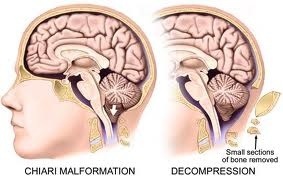
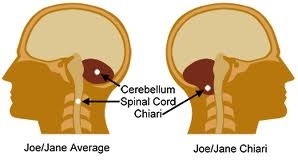
According to Dr. Ham, one of the neurosurgeons there, about 60% of Myelo children with a Chiari II malformation will need decompression surgery. We have not been told this by anyone else so we are still learning more about that. The procedure requires going through the back of the skull and the surgeons typically remove a small section of the skull bone and part of the top two cervical vertebrae.
20121209-213726.jpg

I’m not sure if I have ever explained the Chiari II malformation in detail before on this blog so here you go… The cerebellum, the back portion of the brain, grows a bit differently – it descends partly into the spinal canal and base of the skull.
20121209-213639.jpg
Most every child with Myelo has this malformation. Some are symptomatic and some are not (Colten is not at this point). Studies on the in-utero fetal surgery with these kids is finding that this malformation can be reduced with the fetal surgery. Fetal surgery can also reduce the need for a shunt in some cases. The doctors believe that the inability to process spinal fluid in these kids is due in part to the mixing of spinal fluid and amniotic fluid in the womb. The amniotic fluid kind of alters the brain’s capability in a way and it is then unable to properly work with the CSF.

Back to the decompression surgery. So whether or not a child is symptomatic Chiari or not, there is a 60% chance of needing this surgery at some point in his life. Or 40% that he won’t. I like 40%. I would prefer 60% on the positive side but 40% is better than 20, or 30!

There were also presentations on urological issues, orthopedic concerns, and executive function (thinking, processing, learning, etc…). I can’t say anything stuck out for me in any of those areas but an interaction with another mom at the end of the day revealed an interesting course of events. Based on some other information we’ve encountered, I had the idea that once Colten “put himself” in a wheelchair, he would be in a chair for good, or at least most of the time, if he needs a chair that is. And I’ve struggled with the idea of a toddler in a wheelchair, although that seems to be what families are choosing. There’s a part of me that thinks – “Avoid the chair. Use it as an absolute LAST resort. Push him to stand and walk. Do whatever it takes.” And I know that any amount of standing and/or walking will help build bone density. And as the U of M Kinesiology group presented at the conference, even just standing helps increase respiratory function, muscle function and a laundry list of other things. Walking increases these things even more of course. Then there is the other side of me that thinks – “Take the path of least resistance. Give him whatever device he needs to move as quickly as possible from point A to point B. Does it REALLY matter if he can walk? Stand? Just relax, enjoy what is, and however he grows naturally will be him.”

It’s simply not that black and white. The mother I spoke to said her daughter was in a chair by three – they had started the process to get her one when she was two. She is four now and is exploring forearm crutches. I did a double-take when I heard this. In my head there was a linear progression of mobility aids… leg bracing – walkers, arm crutches, wheelchairs. But as she explained, when her daughter was younger, she wasn’t strong enough to move very well with arm crutches and the wheelchair provided her all the mobility and speed she needed. One of her friends uses arm crutches though and she thinks they’re pretty cool so she asked to try them out at PT and is doing a great job with them. She still opts for her chair most of the time, but she has options. It’s not finite. It’s not absolute. It’s not black and white.

Just like Spina Bifida – not a black and white birth defect. It’s a scattered diagnosis, and even when identical in level/defect, no two children have the same exact innervation. It’s a wait and see kind of thing. That whole thing is aggravating and annoying to me. I don’t have patience for this type of thing and I get that the “wait and see” concept is suppose to be my “lesson” in all of this. I just am having a difficult time accepting and embracing that lesson. In the end, Colten won’t know much of a difference. He’s going to go through life learning how to do things just like all other kids have to learn how to do things. Bit by bit. Some kids learn things easily – some need more assistance. There are things a child never achieves and other things s/he excels at. When you break it down like that, not knowing his future is no different than not knowing my other sons’ futures. So why I have this overwhelming desire to know more about his mobility is sometimes beyond me.

The other new thought that came to me yesterday was – and I wish there would have been an opportunity to ask this question to the group… and I think I will next time I am with an adult with Spina Bifida Myelomeningocele – As an adult, if you could go back and CHANGE something from how your spina bifida was managed as a child, what would you change and why? Would you have wanted more therapy to help you possibly walk or walk better or walk farther? Would you have wanted less therapy because all that work didn’t do as much as you hoped? Was there something your parents/caregivers did that you wish they would not have done? Or what do you appreciate the most about what they did for you? In other words, as a person with spina bifida, what advice can you give to us parents of children with spina bifida?

A lot of these areas go back to just wanting to do the right thing for Colten. It’s not about what we want as parents (well, kind of it is, right?!), it is about what is best for him and his future. We want to give him the best, but it’s hard when you don’t know where to focus your energies. Right now, we’re trying to just enjoy the baby in him. He’s two months and starting to really show off that beautiful smile!
20121209-223335.jpg

20121209-223357.jpg

All Smiles at PT Today

Today was Colten’s first PT appointment with EarlyOn Michigan. He had some appointments back in the hospital, and EarlyOn came to do paperwork and lay out his IFSP a few weeks ago. But today we finally got to work!

I am still struggling with therapies as a whole. Part of me really wants to ignore any therapy or study or trial and just let Colten BE. See what happens later and just let him develop as he is, then he can decide what’s important and worth focusing on. But I also know that if we don’t make the necessary brain-body connections, or we don’t help his body develop in a structurally supportive way, that we are setting him up for more of a struggle. My personal experiences with PT were the result of injuries or surgeries. There was a clear issue, a plan of action, a defined length of time, and a set goal. That goal always included the return of full-function. When I think of Colten engaging in PT work, I have to completely redo my concept of it. He will have various and changing issues over time, with now being the least intense compared to what he will need down the line. He will have multiple and varied plans of action, a never-ending time frame, and many goals throughout his life. Full-functioning in the “typical” sense may never be a reality but functioning to his fullest potential certainly will be! Right now we aren’t sure which therapy or study is going to fit right for him and our entire family. We are still exploring and learning.

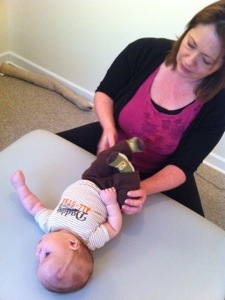
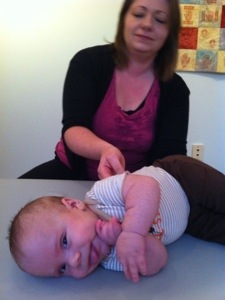
I was quite curious what all PT would even entail at this point since there isn’t a ton he should be doing at two months anyhow. And sure enough, there wasn’t much done compared to what you or I would endure during PT, but it sure tired him out by the end. His therapist worked on getting him to focus on aligning his head “midline”, as he still tends to tip it to one side of his body. She laid him on his back and kind of cuddled her arms into his sides, leaned over him and drew his attention to her. While he was focusing straight up at her, she gently pushed his shoulders down away from his ears – he still is very tight up there. She did some gentle vibrations and he reacted like this:

20121206-205521.jpg

So at least he enjoyed it! She did some stretching of his hip flexors and ankle. We still see him do a slight ankle flexion in the left foot every now and then. No new movements beyond that. The feet are still very floppy. The hip flexors are still tight – he likes his legs up in front of him, not stretched down. While hard to tell with babies this young, there doesn’t seem to be much movement or strength of the hamstrings either.

She ended the session with a few more head control encouragement activities, plus a minute on his belly, and that was it. He was about done anyhow! I was happy that the work she did today was gentle and simple. It didn’t feel “beyond” his current abilities in any way. It didn’t feel forced or over-structured. It was almost as if she was simply aiding his body to relax so he could focus on movement in his own way.

We have another appointment in two weeks, the same day we have a check-in from the treadmill study crew. That same week we also have our first ABM appointment (Anat Baniel Method). (You can read more about both of those items here and an in-depth piece on the treadmill study here.) Should be an interesting week.

I will leave you with one more picture. Here is Colten in his new play yard. Because the TWO we already had were not good enough?! Actually, we purchased this for a specific reason – the piano by the feet. We wanted to provide a more dominant draw to using his legs. So while he probably doesn’t feel much on the bottom of his feet, we hope he can feel the vibration through his leg when he accidentally kicks the keys. That vibration, coupled with the musical response, will hopefully encourage more leg movement. More leg movement builds muscle and the impact on the leg builds bone strength. A special thank you to the Randall Family (especially “C” and “Z”!) for their donation, which was used specifically to purchase this for Colten!

20121206-213456.jpg

I Don’t Want My Son to Walk

This crazy thought has been rattling around in my head for a couple weeks: I don’t want my son to walk. That’s insane, right?! Who wouldn’t want their child to walk?! But there is that thought, rattling around. I can’t seem to shake it. And it makes me feel guilty. Worst mother EVER. Then tonight I finally realized why I have that thought.

20121202-093022.jpg

I will caution you now that this post contains insight into my mental processing. Don’t say I didn’t warn you if you choose to read on.

Richard, Colten and I attended a great Christmas Party this evening for the Spina Bifida Organization of West Michigan. It was enjoyable to spend time with other SB families and meet some new people. When we first walked in we chatted with the father of a 2.5 year old girl who was army crawling around the floor, very comfortable getting to where she needed to go entirely on her own. As Richard and this gentleman talked, I looked around and saw a variety of people moving in a variety if ways. I was drawn to the adorable toddlers dominating the open spaces, each moving at his or her own pace – some in wheelchairs, some using forearm crutches, others with walkers and braces, and some with no assistance at all. And after having a couple quiet weeks at home (medically-speaking at least – our house is never quiet), stepping into that party made the reality come flooding back as I wondered which of those children best represented Colten’s future.

I started to get those overwhelming feelings of uncertainty for the future, for Colten’s future. I want to know what he’s going to be able to do and not do. I want to know if he’ll need braces, crutches, or a wheelchair. I want to know what to prepare myself for, what to prepare him for and what to prepare our family for. With Spina Bifida, those answers aren’t there. We have to just wait and see. I do not like “wait and see”. Not knowing leaves me feeling very out of control. Those of you that know me, know I like control. I like to plan. I like to know what’s coming.

Then I decided to end my self-pity party because in reality, I have no idea what any of my boys’ futures will be like, and the course of their futures could change in an instant, at any time, completely out of our control and even out of their control. There are no guarantees that any child will walk – although we of course assume every healthy, typical child will. There is no guarantee that any child will have exceptional bladder control and become potty trained eventually – although we of course assume every healthy, typical child will. So why can’t I just consider Colten as a healthy, typical child and assume he will walk and potty train and do a million other things just like other children? Or why can’t I focus on the things he can do and will do (although even with typical kids this is still an assumption really) – such as talk, read, write, create, cuddle, laugh, work, have friends, play, cook and more. Partially, I think we have trouble sometimes focusing on the things he will do simply because the things he may not do keep getting thrown at us during paperwork, medical calls, appointments and so on. We are still trying to process his diagnosis and accept it fully.

And then it hit me even deeper. Control. Knowledge. Acceptance. Comfort. Preparation. It isn’t that I don’t want my son to walk, rather, I feel a sense of control if I can just assume he will be in a wheelchair. I can learn about it ahead of time, accept it as our new normal, get comfortable with the idea and make necessary preparations for our family and house ahead of time. So I would know what’s coming next if my son doesn’t walk. The uncertainty, the constant wondering, the unanswered questions… I don’t handle that very well. I like to plan and prepare. And I would rather plan and prepare for the wheelchair and end up with braces, as opposed to plan and prepare for the braces and end up with a wheelchair. This is a complete opposite mentality of how I felt early on after the diagnosis.

So as Richard and I talked about this he then asked why I didn’t refocus myself on therapies to help him walk, or at least move away from the need of a wheelchair. I realized that the therapy options are a bit overwhelming still and I feel like it’s easier to just ignore it in a sense. As he pointed out, I’m not typically a negative person and I don’t choose the easy way out, which would be just letting Colten “be” and not really doing anything. Then we dug a bit deeper and talked about the various therapies and how there really is no guarantee that any therapy will work, or improve his walking, or in the end, prevent Colten from choosing a wheelchair himself. So we could do hours upon hours of therapy, see improvements of varying degrees, and he could still choose or require a wheelchair. And at any point he could have another surgery and come out with less function and we would be back to where we started. It comes down to putting effort towards something and not getting positive results. I don’t like not getting positive results for my efforts and I certainly don’t enjoy paying for services that are not beneficial.

In the end, we realized that we need to learn more about the therapies out there, better understand them, and choose one that is right for our family and for Colten’s future. We need to understand there may be times we move two steps forward and one step back, or even one step forward and two steps back. We need to gain a stronger acceptance of a diagnosis that has no clear answers or predictions. And we need to help Colten be the best Colten he can be.

—–

Colten sitting with Santa at the party for a very brief, crying-filled moment to receive his gift:
20121202-094320.jpg